
The roots of adventure therapy
An old idea with a growing evidence base
Adventure therapy uses adventure experiences, usually outdoors, to engage people in thinking, feeling and doing all at once. People learn most from what they do, and reflection turns the experience into something that lasts.
The belief that challenge, wild places and trusted company change people is much older than the name. Follow the trail.
What we believe
We do not see adventure therapy as a niche activity. For us it is a foundation: a respectful way of working that is high in nurture and high in boundaries, and that helps young people through difficult moments instead of punishing them for having them.
It gives every adult around a young person the same language and something concrete to work towards.
What the research says
Studies have found significant gains in self-esteem, sense of control and behaviour after adventure therapy, in children and adolescents with a range of difficulties. Follow-up work shows the changes can carry on once young people are back at home.
The research is also clear about the limits. For more complex difficulties, a specialised, person-centred approach is needed. That is why we built PMAT with Forensic Psychology Practice.
Sources: Davis-Berman and Berman (1994); James (1993); Garst, Scheider and Baker (2001); Gass, Gillis and Russell (2012); Bowen and Neill (2013), The Open Psychology Journal, 6, 28-53; Trundle and Hutchinson (2021).
Many cultures have sent young people out into wild places with trusted adults, to come back changed and with a new place in their community.
Time outdoors is treated as an ordinary part of living well, not an occasional treat.
Hospitals moved psychiatric patients into tents in the grounds. Many showed significant improvements in their symptoms.
Outward Bound began as challenging adventure training to build tenacity in young sailors. It moved into schools and now runs adventure-based education worldwide.
Gass, Gillis and Russell describe adventure therapy as a discipline: adventure experiences used deliberately by mental health professionals, usually in natural settings.
Bowen and Neill review 197 studies and find a moderate positive effect, well ahead of alternative treatments and no treatment, with gains that last. Older participants gain the most.
We start work with young people referred by local authorities.
Our Phased Model of Adventure Therapy, developed with Forensic Psychology Practice, appears in the Journal of Adventure Education and Outdoor Learning.
More than 250 young people supported and about 490 session plans written. We are working towards CQC registration for personal care for 16 to 19 year olds.
Our published model
PMAT: the Phased Model of Adventure Therapy
Every programme follows PMAT. We developed it with the forensic psychologists at Forensic Psychology Practice. It brings five well-evidenced ways of working together and applies them alongside a programme of adventure and outdoor activity.
Trauma-focused
Built on the Trauma Recovery Model: the right help, in the right order, for where a young person is now.
Low arousal
We keep demands and stress down, so a young person can stay regulated and take part.
Positive behavioural support
We work out what behaviour is communicating and build better ways to meet that need.
PACE
PACE comes from Dyadic Developmental Psychotherapy. It is the basis for how our staff relate to every young person.
A light, interested tone that makes it easier to talk.
Accepting what a young person feels without judgement. Questioning a behaviour is never criticising them.
Wondering what a behaviour means for the young person.
Staying alongside a young person in distress, giving comfort and not walking away.
Cognitive behavioural techniques
CBT techniques are used within low arousal and positive behavioural support. They help a young person understand what leads up to a behaviour, the behaviour itself and what follows.
- A realistic timetable with rewarding activities built in.
- Weighing up the costs and benefits of a choice.
- Reframing an unhelpful thought.
- Questions that help a young person test their own reasoning.
Staff use these in everyday moments. It is not a course of therapy.
Change can't be rushed, so it comes in three phases.
Safety and stabilisation
Feeling safe, settling in, building trust.
Understanding and change
Stretching, reflecting, trying new ways of coping.
Moving forward
Taking what has been learned back home and into the future.
In practice: we regulate first, stretch second and reflect third.
The paper
Trundle, G. and Hutchinson, R. (2021). The phased model of adventure therapy: trauma-focussed, low arousal, & positive behavioural support. Journal of Adventure Education and Outdoor Learning, 21(1), 82-92.

PINE: how we plan every session
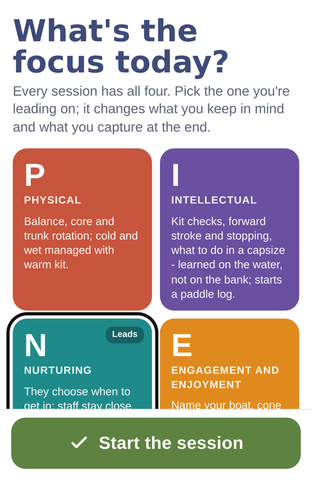
PINE is our own way of planning sessions, built in house by our team. Every session we run is written around four letters, so it is never just an activity.
We have written about 490 session plans this way. Each one shows how to run it from one-to-one up to small groups, with a plan B for a harder day.
Education runs inside whatever we are doing. Sessions are linked to units from AIM, ASDAN, the AQA Unit Award Scheme and the John Muir Award, and to activity awards from NICAS, Paddle UK and the RYA.
Working with psychologists
Planned and reviewed with Forensic Psychology Practice
The therapeutic side of our work is planned and reviewed with Forensic Psychology Practice (FPP), the forensic psychologists who developed PMAT with us. If a commissioner wants it, FPP can add a psychologically focused assessment of risk and behaviours of concern, commissioned separately.
The PINE app
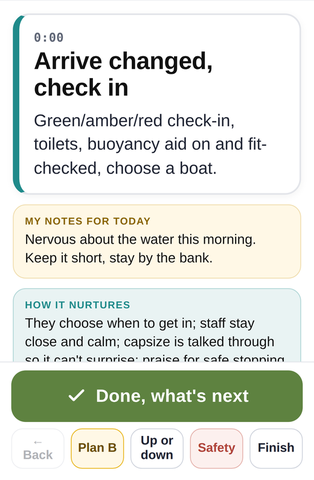
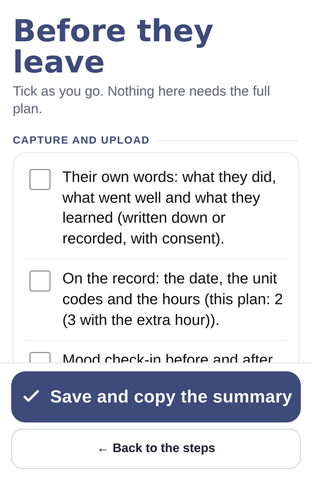
Staff follow the plan on a phone, one step at a time, with plan B and the safety points one tap away. At the end it prompts them to capture the young person's own words and the evidence for any award. The app is in pilot with our team now.
One session, four letters
Paddle 1: Getting afloat
Balance, core and trunk rotation; cold and wet managed with warm kit.
Kit checks, forward stroke and stopping, and what to do in a capsize, learned on the water, not on the bank.
They choose when to get in; staff stay close and calm; praise for safe stopping.
Name your boat, cone slalom, rubber-duck hunt, a photo moment.
Every plan also carries its kit list, timings, a plan B, a step up and a step down, and the evidence to capture for awards.